


Jan 29, 2024
3 | Design and Blockout
- Izzy Foo
- Feb 7, 2024
- 3 min read

Updated: May 8, 2024
Now it was on to designing.
In order to help visualise the 3 floors, I began with stacking 3 rectangles on the page and the plan was to confine each floor to each rectangle. This was the base upon which I began to draw.
To begin with I stayed very close to my reference material, directly lifting shapes from buildings. The shopfront in my first design is inspired by the Maion A Niguet, designed by Paul Hankar in 1896 and the roof-dome (thing?) in the second design I drew after seeing some glass, domed roofs from buildings by Victor Horta.
My third attempt came around after beginning to push at the style limitations I had set myself, this is the world of Harry Potter after all. I planned a moon gate entrance and a wrap-around balcony, complete with traditional guardian lion statues. Finials dotted the roof, and a bay window decorated the front.
When designing the railings, I wanted to obtain inspiration and motifs from flora predominantly present in Chinese culture. The plum blossom is associated with winter, being a “metaphor for an indomitable spirit of inner beauty and modesty in adversity.” (Zong, 2020) and I felt this appropriately described the determination it would have taken to uproot and move oneself so drastically.
I felt much better about this design, apart from the roof. I didn’t feel good about the roof. The plan was always to have a sloping roof, but I was not vibing with the open feel and all the iron work which would have to be hand sculpted. My solution was to style it more after the style of roof found on the pagodas..

Now. I had a problem. All of these lines were parallel. This shop would never fit into Diagon Alley (the clue is in the name), time to warp all of the walls so it becomes structurally unsound! This was quick and painless, and soon I had a much wonkier building. This I felt much better about and proceeded to try my hand at making a blockout

Before I could think about primitives, the grid had to be fixed. We are confined to a 600x600cm plot each and must stay within those boundaries. Altering this was painless and fast, and offered me a nice amount of space to work with.
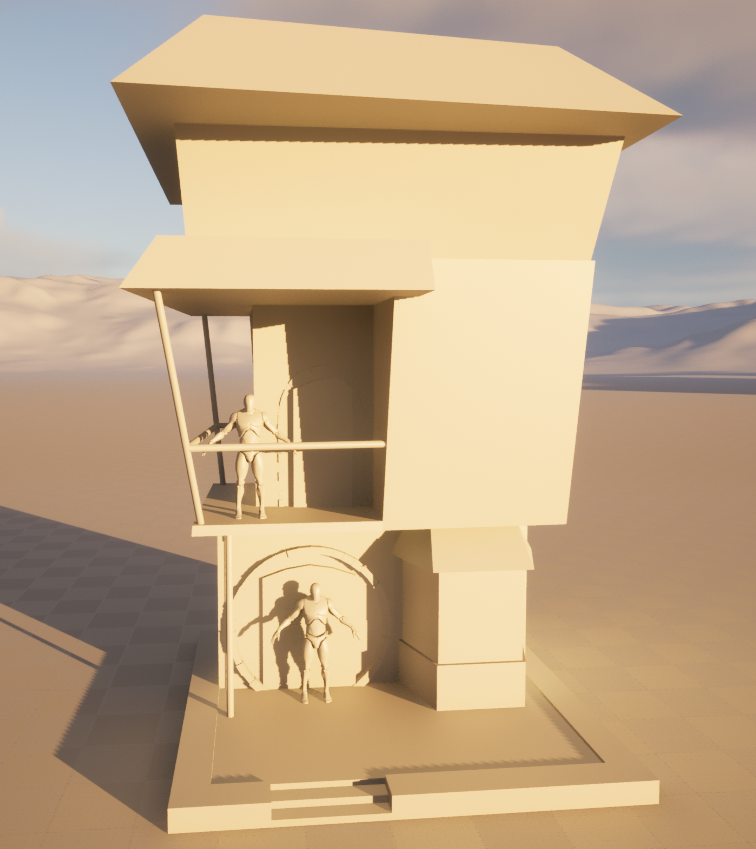
My very first blockout was fairly painless, add a cube, stretch it, position it, repeat. I was able to quickly get the rough shapes of my building into position in Maya.

Taking a few steps back and observing the 3D masterpiece that is 30 minutes of work in Maya, I decided that this was probably not enough detail. Doorways were my next port of call, people had to be able to get inside, right?
The doorway I created at first was basically a Torus, expanded, most of the faces deleted, and gaps bridged. Very basic. Too Basic?

My next port of call was a process I had seen on the internet last semester when looking into modelling techniques. Someone had made a row of bricks, randomised the size within a bound and then applied a bend modifier to curve them into a shape of a doorway. I had planned to have brickwork around the Moon gate, and this was an option I had wanted to explore anyway, why not now!


The Magical Microcosm of Modifiers is something I haven’t properly explored in Maya, and I was astounded by how simple they were to use and upset I had not explored them properly before? The discovery of this menu was a revelation! The use it could have for curved architecture and windows!
My new fancy brickwork was complete for 2 doorways, (complete with modified cubes that you could call doors) and I felt a bit better about my blockout. The sign has not been properly designed yet so I did leave it out of the blockout, but it will hang from the second floor on the right.
Having been excited to work in Unreal Engine since the start of this semester, I imported my model into the game engine... and promptly did nothing else because I was not mentally prepared to learn a new UI.
That’s a challenge for a future Iz :)
REFERENCES
VISIT.BRUSSELS. (n.d). Maison A Niguet. [online]. Available at: https://www.visit.brussels/en/visitors/venue-details.Maison-A-Niguet.263123 visit.brussels
ZONG, Fang. (2020) FOUR NOBLE PLANTS IN CHINESE CULTURE, PART I: PLUM [online] Available at: https://storiesfromthemuseumfloor.wordpress.com/2020/03/13/four-noble-plants-in-chinese-culture-part-i-plum/ storiesfromthemuseumfloor


Comments